Well, last night I finished the final voyage of the Battlestar Galactica.
And it was AWESOME!
I know, the ending is a "love it or hate it" thing, but I liked it. It tied back to the original series, which suggested that "life here began out there". In a way, that notion of thinking is fascinating. If we are in fact space travelers, then where were we from?
One thing I liked was the flashbacks. It gave glimpses into the lives of almost all the main characters in the time before the fall of the Twelve Colonies. The one I particularly liked was Baltar and his father. Even though he had previously said he completely turned his back on his family heritage, seeing him having his father on Caprica did in fact give a subtle hint that he isn't a completely selfish jerk. To me, that was a bit of foreshadowing to his decision to stay on Galactica for its final mission.
Once again, I feel this to be what Voyager should have been. The latter had all the elements in place to be an epic series, but it didn't make use of them. BSG had all the elements and made fantastic use of them, such great use that fans of the original series actually decided to tune in for Part 2 of the miniseries. I have seen the first episode of the original, and while it is pretty awesome, I do feel that it is a bit too fantastical for my tastes (like using a new word instead of "year").
"Daybreak" is another example of how Voyager could have ended. As I said in my comments on the episode, if time travel is so easy, why didn't Sisko try to avert the Dominion War? "Daybreak" didn't have some crappy time travel scheme to alter the past so Galactica got to Earth or prevent the destruction of the Colonies. It was a simple final battle for an old ship on its last mission, the ship and its commander due to retire together before the apocalypse happened going for one last spin.
Don't get me wrong. I do love both franchises, but in watching Battlestar, it was refreshing to see a sci-fi show with so much...uh...what's the word...oh right, "common sense". For example: kinetic weapons, the bridge being deep within the ship instead of at the top (though we did kind of get that with Defiant), and no anomalies. If there is a future Trek series, I personally hope it takes a lesson or two from the brave crew of the Battlestar Galactica.
Thursday, September 29, 2011

Thursday, September 22, 2011
Let That Be Your Final Battlefield
Season 3 of the Original Series is rather infamous. By Season 2, the network decided they had had enough and wished to pull the plug on it. A fan letter campaign managed to save the show, but those network executives decided on a more devious means to kill the show: by slashing the budget (to the point where Gene had enough money to make a good radio program) and of course, moving it to the Friday Night Death Slot. As a result, the season lagged, as evident from the fact that "Spock's Brain" kicked it off. Of course, a few gems managed to find their way into this mess of a season.
This episode opens with the rarest of occasions: the Captain actually talking in his Captain's Log. I'll say this, I do like the idea of the Captain's Log. It's an efficient way to dump exposition in a reasonable fashion within the confines of a television episode. Still, I am often peeved when I see the captains in highly dangerous situations and taking the time to update their log, especially in "Q Who?" when Picard says "We are unable to outrun the Borg!" Do they just have microchips implanted in their heads? "The Cloud" seems to suggest that, when Janeway seems to just think and the computer deletes the last bit of her log.
Back on topic, the Enterprise is on a mission to decontaminate a planet. One of the species has become infected and if they fail, they'll have to implant another species to avoid eco-collapse or the alliance with the Klaggialliavoa will be threatened in the name of Spode! While on route, they come across a shuttle that a starbase reported stolen. This is back in the days when Starfleet had about a dozen or so bases around, because Gene hadn't yet realized how big the galaxy is.
I will make another diversion to say this: I...LOVE...the remastered episodes. Yes, there are puritans out there who will join the angry Warsians in destroying the blu-ray edition, but personally, I have no problem with the changes to TOS. Unlike the Original Trilogy, these changes are improving effects that were SEVERELY lacking (especially in Season 3). They aren't rewriting history by having the Enterprise firing first against the Romulans. They're adding to the continuity; in "The Enterprise Incident", they added the original Romulan Bird-of-Prey since they had lost the model back in the 60s (although personally I'd have one Klingon design and two Birds-of-Prey for a nice command ship with escorts shot).
They bring in the shuttle in a not-reused-from Season-1-stock-footage (thanks to CGI!) and Kirk and Spock discover the pilot: a man who is white on one side and black on the other (no, not the human skin tones, but the actual colors). The Big Three ponder over whether this is a one-of-a-kind entity before waking him. Lokai introduces himself as a political fugitive from the planet Cheron, located in the "southern-most part of the galaxy". To those who don't know, the proper terminology in galactic directions is coreward, rimward, spinward, and trailing.
Then, the Russian whiz-kid reports a ship approaching. They can see it on sensors, but not visually...and for this incredibly idiotic scene, please mail all your blame to the 1968 executives at NBC. The ship disintegrates and deposits its passenger Bele, who is of the same race as Lokai (species-race, not the idea of race used to differentiate outsiders in order to destroy them). We then get the beginnings of buildup to the episode's conclusion. Bele pulls off his best Dukat impression, saying that they were helping Lokai's people while Lokai says that Bele's people were butchers and enslavers.
After this, Kirk learns that Bele has literally taken control of the Enterprise with the power of the mind (his people can do that, you know). Then...ugh, we get the one really bad part of the episode: the self-destruct scene. Kirk, Spock, and Scotty activate the system, and I have to wonder...what the hell was Starfleet thinking when they designed their self-destruct system?! It takes a good two minutes to set it up before the countdown starts, right in the presence of the alien in control of the ship. By having three officers verifying it by slowly giving the command codes, ample time is given to any hostile force to simply kill the officers. By, anyway, the franchise must continue so Bele relents and the self-destruct is deactivated.
The Enterprise returns on course to the infected planet. Meanwhile, Bele and Lokai try to appeal their sides to the crew; Lokai trying to convince the junior officers while Bele goes for the senior staff. As they go on, it's shown than neither side is right and neither side is wrong. They're both guilty of atrocities in the name of their sides. Also, it's a tad ridiculous when Sulu says "But all that racism was in the 20th Century. There's no such thing today", again cementing the 20th Century as a horrible time period in history. As we all know, once the year 2000 rolled around, there was never again any racism, or paranoia, or reckless sustained conflict, and I'll just shut up now.
One thing I especially like in this episode is that it shows just how unflappable Kirk is. Ever since Lokai comes aboard, all Kirk wants to do is hold him accountable for his one obvious crime: stealing a Starfleet shuttlecraft. He makes it especially clear in his dealings with Bele; his immediate duties come first before anything else. This helps set the standard against which the other Trek captains will be based on; how great is duty to them. Picard: able to talk down even Godlike beings. Sisko: willing to bend the rules to win a war. Then we get Janeway who dismantles a potential ticket home because it didn't work the first time and the countless atrocities committed by Captain Jonathan Archer which will probably have to wait for a future post.
After Bele tries to get Kirk and Spock on his side, Scotty has one of his most badass moments: being in command of the Enterprise during a decontamination mission. The remastered version truly improves this scenes. After that, Kirk orders them back to starbase, but Bele once again seizes control, this time knocking out the self-destruct. One can only wonder why he didn't knock it out the first time when Kirk was gloating about how he's in charge, but the episode is almost over. They come across Cheron, once again transcending possibly thousands of lightyears in a matter of hours. They arrive and...yeah, it's a pretty sad sight.
Spock reports that the entire population is dead, killed off by the brutal racial conflicts. It is quite painful to watch, not just the idea of an entire race nearly extinct, but now the two known survivors...still hate each other. They still blame each other for their world's annihilation and proceed to run through the corridors before beaming back, no doubt to continue their cat and mouse game for another 50,000 years on a dead world. Kirk manages to pull off at least some emotion during this, but then, he's Kirk. It would take his best friend dying or something to get him to truly show emotion within his awesomeness.
This episode manages to pull off something that Star Trek has become renowned for: social commentary. We see the pain and suffering created by something so simple as difference in skin tone, while not doing it completely in a preaching way. Aside from writing, the acting is pretty well off, with Bele and Lokai both trying to impress parts of the crew to their side. This and "The Enterprise Incident" are two episodes I would strongly recommend from Season 3. The two beings who have nothing left just continue their fight, with hate being all that they know.
Final Score: 9/10
 |
| ...and...that is just about... every reason why I am...awesome. |
Back on topic, the Enterprise is on a mission to decontaminate a planet. One of the species has become infected and if they fail, they'll have to implant another species to avoid eco-collapse or the alliance with the Klaggialliavoa will be threatened in the name of Spode! While on route, they come across a shuttle that a starbase reported stolen. This is back in the days when Starfleet had about a dozen or so bases around, because Gene hadn't yet realized how big the galaxy is.
I will make another diversion to say this: I...LOVE...the remastered episodes. Yes, there are puritans out there who will join the angry Warsians in destroying the blu-ray edition, but personally, I have no problem with the changes to TOS. Unlike the Original Trilogy, these changes are improving effects that were SEVERELY lacking (especially in Season 3). They aren't rewriting history by having the Enterprise firing first against the Romulans. They're adding to the continuity; in "The Enterprise Incident", they added the original Romulan Bird-of-Prey since they had lost the model back in the 60s (although personally I'd have one Klingon design and two Birds-of-Prey for a nice command ship with escorts shot).
 |
| Unlike the Ewoks, I am iconic enough to not be digitally altered! |
Then, the Russian whiz-kid reports a ship approaching. They can see it on sensors, but not visually...and for this incredibly idiotic scene, please mail all your blame to the 1968 executives at NBC. The ship disintegrates and deposits its passenger Bele, who is of the same race as Lokai (species-race, not the idea of race used to differentiate outsiders in order to destroy them). We then get the beginnings of buildup to the episode's conclusion. Bele pulls off his best Dukat impression, saying that they were helping Lokai's people while Lokai says that Bele's people were butchers and enslavers.
After this, Kirk learns that Bele has literally taken control of the Enterprise with the power of the mind (his people can do that, you know). Then...ugh, we get the one really bad part of the episode: the self-destruct scene. Kirk, Spock, and Scotty activate the system, and I have to wonder...what the hell was Starfleet thinking when they designed their self-destruct system?! It takes a good two minutes to set it up before the countdown starts, right in the presence of the alien in control of the ship. By having three officers verifying it by slowly giving the command codes, ample time is given to any hostile force to simply kill the officers. By, anyway, the franchise must continue so Bele relents and the self-destruct is deactivated.
 |
| Alright, your blessed planet is saved. Now, where the devil are my Sporebucks? |
One thing I especially like in this episode is that it shows just how unflappable Kirk is. Ever since Lokai comes aboard, all Kirk wants to do is hold him accountable for his one obvious crime: stealing a Starfleet shuttlecraft. He makes it especially clear in his dealings with Bele; his immediate duties come first before anything else. This helps set the standard against which the other Trek captains will be based on; how great is duty to them. Picard: able to talk down even Godlike beings. Sisko: willing to bend the rules to win a war. Then we get Janeway who dismantles a potential ticket home because it didn't work the first time and the countless atrocities committed by Captain Jonathan Archer which will probably have to wait for a future post.
 |
| So, which of us will be the Doctor and who will be the Master? |
Spock reports that the entire population is dead, killed off by the brutal racial conflicts. It is quite painful to watch, not just the idea of an entire race nearly extinct, but now the two known survivors...still hate each other. They still blame each other for their world's annihilation and proceed to run through the corridors before beaming back, no doubt to continue their cat and mouse game for another 50,000 years on a dead world. Kirk manages to pull off at least some emotion during this, but then, he's Kirk. It would take his best friend dying or something to get him to truly show emotion within his awesomeness.
This episode manages to pull off something that Star Trek has become renowned for: social commentary. We see the pain and suffering created by something so simple as difference in skin tone, while not doing it completely in a preaching way. Aside from writing, the acting is pretty well off, with Bele and Lokai both trying to impress parts of the crew to their side. This and "The Enterprise Incident" are two episodes I would strongly recommend from Season 3. The two beings who have nothing left just continue their fight, with hate being all that they know.
Final Score: 9/10
Thursday, September 15, 2011
Announcement and Ramble
Well, I've been rather busy this week: campaigning, writing lesbian Vorta stories, taking lessons from The Christian Left, arranging my triumphant return to my friends. Above that, I am still watching Netflix: Voyager, Battlestar, and more recently, The X-Files.
I've reached the halfway point of Voyager Season 2, with the following episode being the infamous "Threshold". Everything inside me is telling my brain to not continue, and in some ways, I want to listen. It's a boring show. They had a funeral for a redshirt...that we didn't even see him before so we cannot even care! However, it might be my German efficiency or my Russian stubbornness, but I will watch every episode of Voyager. Once I do, maybe the Janeway fans who accuse people who don't like it of being misogynistic pigs will take me seriously. Honestly, I know several women who don't like Janeway...
As for Battlestar, I find this to be a masterpiece. I find it to be everything that Voyager could have been: conflict amongst the crew, breaking the rules, a Mexican in command. If it seems that I am constantly comparing shows, I am. I still feel that Voyager wasted so much potential and could have been an epic space opera. For reasons which I posted last week, I am still finding trouble liking it.
Now, The X-Files used to scare the crap out of me. Finally, I have started to watch it. I'm on episode 2, and already I find it to be a pretty interesting show. Still, the acting could do with some tweaking here and there, but I've been told that the show does improve. Mulder and Scully have some pretty good chemistry, even if David Duchovny does tend to overact (remember when I brought up the acting?). The theme song...is still hauntingly beautiful. I would sometimes listen to it younger and cower in fear. It is simple, yet elegant. Creepy, yet fascinating.
Anyway, I will be writing proper reviews in the weeks to come. Next week I'll take on racism with "Let That Be Your Last Battlefield" and then I will be giving a positive review for an episode of Voyager. Which episode will that be? Well, stay tuned!
I've reached the halfway point of Voyager Season 2, with the following episode being the infamous "Threshold". Everything inside me is telling my brain to not continue, and in some ways, I want to listen. It's a boring show. They had a funeral for a redshirt...that we didn't even see him before so we cannot even care! However, it might be my German efficiency or my Russian stubbornness, but I will watch every episode of Voyager. Once I do, maybe the Janeway fans who accuse people who don't like it of being misogynistic pigs will take me seriously. Honestly, I know several women who don't like Janeway...
As for Battlestar, I find this to be a masterpiece. I find it to be everything that Voyager could have been: conflict amongst the crew, breaking the rules, a Mexican in command. If it seems that I am constantly comparing shows, I am. I still feel that Voyager wasted so much potential and could have been an epic space opera. For reasons which I posted last week, I am still finding trouble liking it.
Now, The X-Files used to scare the crap out of me. Finally, I have started to watch it. I'm on episode 2, and already I find it to be a pretty interesting show. Still, the acting could do with some tweaking here and there, but I've been told that the show does improve. Mulder and Scully have some pretty good chemistry, even if David Duchovny does tend to overact (remember when I brought up the acting?). The theme song...is still hauntingly beautiful. I would sometimes listen to it younger and cower in fear. It is simple, yet elegant. Creepy, yet fascinating.
Anyway, I will be writing proper reviews in the weeks to come. Next week I'll take on racism with "Let That Be Your Last Battlefield" and then I will be giving a positive review for an episode of Voyager. Which episode will that be? Well, stay tuned!
Thursday, September 8, 2011
My problem with Voyager
As I've said before, Enterprise was the only series which I watched as it aired. When watching TNG and TOS, I tend to restrict myself to the best episodes and occasionally the "so bad it's good" ones. DS9 was the first series I watched following the release of Trek XI, and it was amazing. It was one of the most enjoyable programs I saw from start to finish.
That said, I am now watching Voyager. Now, I have friends who like Voyager, and we have friendly discussions over the quality of the program. However, once when I tried to bring up my problems with it, someone accused me of being a misogynistic and shameless conservative idiot who hates the idea of a woman being in command.
To quote Penn Jillette, this accusation...is bullshit.
Now, I like Sisko. I feel he is the best captain in the franchise. I have come into contact with plenty of people who don't like Sisko, or DS9. I have never accused them of being racist towards him, and of course I listen to the reasons why they don't like DS9 (mostly revolving around "it's not Star Trek since they stay in one place"; well, DS9 did do some exploring, but I understand). They have an opinion, I disagree with it, but we still stay on good speaking terms.
Overall, this show is just...bad. It is using plots that have already been seen to death on the other series. They aren't making good use of what they have, which is plenty of material for story arcs and character development. I'm literally struggling to maintain interest in this series, a show that was the first sign Trek was running out of gas. My problem with Janeway isn't that she's a woman; it's that she's not a very good captain.
Again, I want to stress that this is my opinion. I'm looking at both sides and drawing my own conclusion. If you feel that Star Trek: Voyager is the best series and that Janeway is a model for women everywhere, that's fine and that's your right. That being said, the moment you try to plug your ears and ignore any criticism of the show, the characters, or Brannon's writing, accusing objectors of being idiots, you have more or less lost my respect. If you think this is a great show, I'm willing to listen to why you think so, and more importantly, I'm expecting you to know why I see it as a low point.
Now, I feel this is overdo. In watching the first season and a half of Voyager, I will now explain my problem with it.
1) Plot from a plot hole: While it's always fun to point out the plot holes of a movie or show, it doesn't really help when the movie or show is dependent on a plot hole. Take a look at "Caretaker". The episode establishes that Janeway is an excellent scientist. So...why is she being sent on a counterterrorism mission? Sisko, his staff of combat veterans, and the Federation's first true warship are stationed right next to where the Maquis live. Who cares if it was Janeway's security officer? If they wanted it done well, why not just ask Sisko? He hasn't gone anywhere around this time, and he seems to spend most of his time at the door waiting to exit for some new mission.
2) What amazing teleportation tech you have: Upon arriving in the Delta Quadrant, Voyager immediately comes into contact with people who are astonished by their transporter. Talk about this tech seems to spread like wildfire and the whole quadrant is astonished. Okay, I like how the Delta Quadrant is extremely disorganized compared to the orderly Gamma Quadrant and a bit less advanced, but there has to be some logic here. If everyone has warp drive and disruptors, shouldn't they have transporters as well? That would be like if Iran had nuclear reactors and used biplanes and muskets in its military.
3) Wait...didn't we hate each other...: One thing I love in drama is character conflict, two people from different sides who try to plot against each other. "Caretaker" tried setting this up, by establishing that Tom and Chakotay hate each other. And then...it all gets resolved at the end. Yeah, way to throw away years of potential plot lines! Also, the fact that the Maquis and Starfleet crews are able to integrate so flawlessly really bugs me. Once again, look at Battlestar Galactica. There is tension between the civilians and the military at the end of the miniseries, tension which I can assure you does not go away by the end of the show.
4) Remember, writers, to tell and not show: Let me stress this again: when writing, it's better to show, not tell. I know it's a TV show and severely limited by time, but the plot of "The 37's" was just bloody embarrassing. How could we feel for the crew and their dilemma when we don't see for ourselves what the cities look like? I should have stopped watching with "The 37's", but sadly I still have five and a half seasons to go, and I cannot help but think it gets worse from here.
5) Consistency? What's that?!: I cannot stand inconsistency. Possibly the biggest offender is Neelix. I like the concept, a scavenger who knows his way around the Delta Quadrant, but he seriously lacks in this. What's more, he is horribly inconsistent. In one episode, he knows everything about the Kazon; in another, he is such a bad cook that he makes the ship itself sick! Look, Neelix should be either the comic relief or the scavenger with a heart of gold. He is not in any way resembling Quark.
In all, I can say I am not enjoying the show. It's a mess of plot holes and inconsistency that would make Tommy Wiseau blush. I will one day finish watching Voyager, even if it takes me years to do so. Even to make it worse, the Kazon are horrible villains! It's hard to take them seriously when their hair looks like a collection of things from the dump. Whenever I see them, I wish they would just take off their ridiculous makeup and start quoting Nietzsche, like the bad guys on a more interesting show (my first Andromeda reference!). Yes, Voyager has its high marks, but they are far too few and in between.
All in all, I would like to wish all Trekkies a Happy Premiere Day (9/8/66), and a reminder that despite this low, Star Trek does have its high points.
That said, I am now watching Voyager. Now, I have friends who like Voyager, and we have friendly discussions over the quality of the program. However, once when I tried to bring up my problems with it, someone accused me of being a misogynistic and shameless conservative idiot who hates the idea of a woman being in command.
To quote Penn Jillette, this accusation...is bullshit.
Now, I like Sisko. I feel he is the best captain in the franchise. I have come into contact with plenty of people who don't like Sisko, or DS9. I have never accused them of being racist towards him, and of course I listen to the reasons why they don't like DS9 (mostly revolving around "it's not Star Trek since they stay in one place"; well, DS9 did do some exploring, but I understand). They have an opinion, I disagree with it, but we still stay on good speaking terms.
Overall, this show is just...bad. It is using plots that have already been seen to death on the other series. They aren't making good use of what they have, which is plenty of material for story arcs and character development. I'm literally struggling to maintain interest in this series, a show that was the first sign Trek was running out of gas. My problem with Janeway isn't that she's a woman; it's that she's not a very good captain.
Again, I want to stress that this is my opinion. I'm looking at both sides and drawing my own conclusion. If you feel that Star Trek: Voyager is the best series and that Janeway is a model for women everywhere, that's fine and that's your right. That being said, the moment you try to plug your ears and ignore any criticism of the show, the characters, or Brannon's writing, accusing objectors of being idiots, you have more or less lost my respect. If you think this is a great show, I'm willing to listen to why you think so, and more importantly, I'm expecting you to know why I see it as a low point.
Now, I feel this is overdo. In watching the first season and a half of Voyager, I will now explain my problem with it.
 |
| The best way to improve this scene is to have a Mexican actor whose face looks like the dark side of the moon. |
1) Plot from a plot hole: While it's always fun to point out the plot holes of a movie or show, it doesn't really help when the movie or show is dependent on a plot hole. Take a look at "Caretaker". The episode establishes that Janeway is an excellent scientist. So...why is she being sent on a counterterrorism mission? Sisko, his staff of combat veterans, and the Federation's first true warship are stationed right next to where the Maquis live. Who cares if it was Janeway's security officer? If they wanted it done well, why not just ask Sisko? He hasn't gone anywhere around this time, and he seems to spend most of his time at the door waiting to exit for some new mission.
2) What amazing teleportation tech you have: Upon arriving in the Delta Quadrant, Voyager immediately comes into contact with people who are astonished by their transporter. Talk about this tech seems to spread like wildfire and the whole quadrant is astonished. Okay, I like how the Delta Quadrant is extremely disorganized compared to the orderly Gamma Quadrant and a bit less advanced, but there has to be some logic here. If everyone has warp drive and disruptors, shouldn't they have transporters as well? That would be like if Iran had nuclear reactors and used biplanes and muskets in its military.
 |
| It's okay, Aron Eisenberg. You'll grow up to have a far more interesting character than this bit part. |
4) Remember, writers, to tell and not show: Let me stress this again: when writing, it's better to show, not tell. I know it's a TV show and severely limited by time, but the plot of "The 37's" was just bloody embarrassing. How could we feel for the crew and their dilemma when we don't see for ourselves what the cities look like? I should have stopped watching with "The 37's", but sadly I still have five and a half seasons to go, and I cannot help but think it gets worse from here.
 |
| Young Chakotay, I survived three days in the Adirondacks and intend to hike Hadrian's Wall. I think you can suck up this little nature hike! |
In all, I can say I am not enjoying the show. It's a mess of plot holes and inconsistency that would make Tommy Wiseau blush. I will one day finish watching Voyager, even if it takes me years to do so. Even to make it worse, the Kazon are horrible villains! It's hard to take them seriously when their hair looks like a collection of things from the dump. Whenever I see them, I wish they would just take off their ridiculous makeup and start quoting Nietzsche, like the bad guys on a more interesting show (my first Andromeda reference!). Yes, Voyager has its high marks, but they are far too few and in between.
All in all, I would like to wish all Trekkies a Happy Premiere Day (9/8/66), and a reminder that despite this low, Star Trek does have its high points.
Thursday, September 1, 2011
The 37's
In the long 40 year history of Star Trek, there are a few episodes that have become synonymous with awful. The most hated episodes that would not be touched by fans with a ten foot cattle prod: "Spock's Brain", "Shades of Grey", "Profit and Lace", "Threshold", "A Night in Sickbay", and others. Of course, these tend to shift from person to person, but these ones are generally regarded as some of the worse. That said, there is one episode which I fell is not bad enough to be counted with these, but it's bad in another category: season premieres. That being said, this is "The 37's", one of the worst openers of Star Trek.
Interesting tidbit about this episode. It was originally supposed to be the Season 1 closer. But, the executives thought it would work better as the Season 2 opener. It may have slightly worked better as a finale, but that's a pretty big bit of optimism. The episode still falls flat on its face and is what I consider to be a horrible mess. In addition, some bright spark said "let's air the first bit of Season 2 out of order!" Yeah, I always hate it when they do that, raising continuity issues and such. Alright, enough stalling. Let's get this one over with.
This episode opens with the crew of Voyager detecting rust in space. They come across a poorly photoshopped truck floating in space, which Tom is able to immediately determine is an ancient Earth vehicle known as an "automobile". Yeah, once again they're doing that stupid "ancient" thing. Okay, some will view "ancient" as being anything before a new era. While First Contact is a truly important event, is it really that important compared to something like the dawn of intelligence? After all, when you begin encompassing World War II and the Gallic Wars within the same time period, it does tend to get a little ridiculous.
They bring the truck on-board, magically turning it from a photoshop to a real thing. Tom takes a look around and immediately begins saying everything about it, explaining how "'36 Ford" was the ancient Earth way of saying the manufacturing year and the company that made the truck. Yeah, the crew of Voyager is so stupid that they have even this explained to them, as I'm sure vehicles are still called this way. Oh, and it gets better. Harry shows his genius and asks if the vehicle is an early hovercar. In a way, it is, the same way a typewriter is an early computer.
Perhaps I'm being a bit too harsh, because it's clear that this is simply a Holmesian situation. Torres is examining the back of the truck with a tricorder, and is unable to identify that the "traces of potassium nitrate, ammonium and methane" is manure, while Janeway is able to immediately determine that this belong to a farmer. How is this Holmesian? Well, Sir Arthur Conan Doyle wrote almost all Sherlock Holmes stories entirely from Watson's POV. Now, Watson is an intelligent man; he's a competent doctor and a decorated war hero. However, he's not as observant as Holmes is (and good thing; if they were written from Holmes' POV, the stories would be done in a few paragraphs) and it mostly served to make Holmes appear awesome. Same here. Jeri Taylor wrote this episode to show how awesome Janeway is, much like every other episode she penned. It's one thing to misinterpret what the initials on a cane mean; it's another to not know what the hell manure is!
Tom gets into the truck and manages to bring it back to life, startling the crew. Tuvok even pulls out his phaser upon hearing the car start up. Once again, it gets better. Tom begins flipping through the old AM/FM radio, picking up what Torres calls "the ancient Earth distress call known as SOS" (might be too soon, but just roll with it). They didn't pick this up because Voyager doesn't normally scan those areas. Going on, they trace the SOS signal to a planet which has a technobabble atmosphere that conveniently prevents shuttles and transporters. Thus, that leaves one solution: landing the entire ship. Voyager's equipped to do that, you know.
So, Voyager lands in what actually rivals the slow reconnection of the Enterprise in "Encounter at Farpoint", of a special effect put in simply because they could. Not knowing they are being watched (even when using tricorders, their source of everything), they find an "ancient Earth aircraft". Once again, I rub my head at the idea that airplanes are considered "ancient". In someways, that's one thing Enterprise did right: they used "old", not "ancient" to describe pre-First Contact things. By the way, the most idiotic stuff is yet to come. Still not seeing the humanoid stalking them, they find a cave filled with people in suspended animation that they are able to determine as being from the same time period as the truck. Heh, the officers cannot identify manure from the sight and smell, but they are able to determine decade from clothing. Oh wait, it's Janeway who determines what time period they are from.
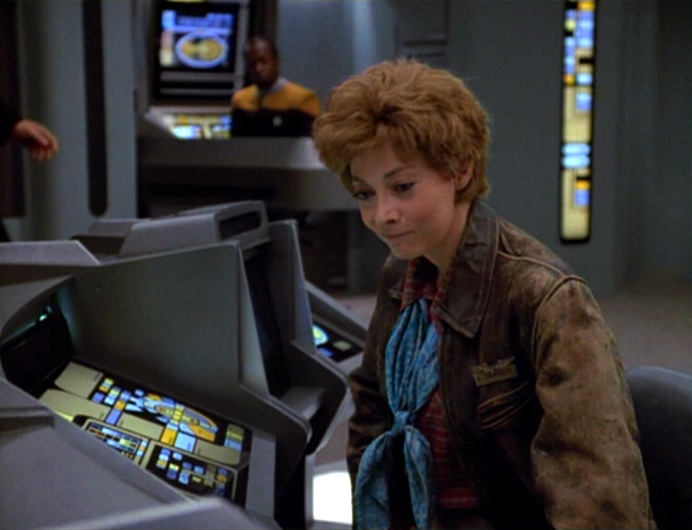
Then...Janeway has a Shatner-moment. She comes across a woman that is wearing a leather jacket and the name tag "A. Earhart". She observes this by saying "A...period...E-A-R-H-A-R-T". Rather than just sounding out the name, she spells every letter and then has a eureka moment by saying "Amelia Earhart". A potentially good twist...if not that the credits listed Sharon Lawrence as "Amelia Earhart". Yeah, this scene seems to just draw out what we already know. Thus, it'd be better to either have Lawrence's character not listed in the credits, or have Janeway just say "Earhart".
So, they go back to Voyager and Harry asks who Amelia Earhart is. Now, normally, I'd be generous and say that Harry genuinely does not know who Amelia Earhart was; after all, not too many Americans may know who Charles Carroll was (the only Catholic to sign the Declaration of Independence). However, why would Harry wait until they got back to Voyager to ask who she was? That's one problem I often have with cinema and television; a conversation is going on in a normal fashion, but there's a change in location that should have taken several minutes. Anyway, Janeway goes into an almost fangirl craze in describing everything about Amelia Earhart, including her disappearance in 1937. She tells the officers to brush up on "ancient Earth" before reviving them; yeah, Kathy, you'd might want to be a little more specific.
They bring Kes along, since it's still before the Doctor can make house calls. Tom points out the Japanese soldier is armed "with some kind of weapon"; huh, he can identify a '36 Ford but doesn't know what a Nambu pistol is (or just a handgun in general)? As Amelia Earhart exits her cryochamber...God, I cannot get over that weird smile Janeway has on her face. It's less a sign of "Wow, I'm meeting my hero!" and more of "I want to play a game. Behind your eye is the key..." through a talking puppet. Naturally, Amelia Earhart, her navigator Fred Noonan, a Japanese soldier, a black farmer, and some other people who never get a line are startled and don't believe Janeway's story. Well, at least they're showing they're not as gullible as the people of Grover's Mill, New Jersey. Janeway tries to explain by revealing that Kes is an alien, and okay, there's one funny bit. Amelia Earhart refuses to believe that Martians have invaded Earth, but Harry says "it's the other way around. Earth colonized Mars."
Still, Fred refuses to believe them and takes the group hostage. Janeway manages to convince Amelia Earhart to talk him down, saying that people believed after Pearl Harbor that her flight around the world was an intel mission. To this, she replies "no one was supposed to know about that", almost acknowledging that she was not trying to break new ground for women, but to gather intel on the Japanese! Smart move, Jeri and Brannon! As if the "alien abduction" theory wasn't enough, you had to say the intel mission was true! Meanwhile, Chakotay and Tuvok, two men highly trained and experienced in guerrilla warfare, are ambushed while trying to rescue the officers by the people who were stalking them earlier.
Janeway, of course, gets to play action girl and outflanks the attackers, learning that they are human as well. The leader, John Evansville (yes, really), returns with them to Voyager for the almighty task of overacting. He explains the backstory of this planet: in 1937, an alien race abducted 300 humans and brought them here. The human slaves eventually overpowered the aliens and destroyed them. Yeah, this would eventually be reused in Enterprise, in a slightly better way. Now, the plot holes this monologue raises are painfully obvious, like why these aliens would go across the galaxy for humans when they are so many races that would make better slaves in the Delta Quadrant? Also, I have to wonder how these guys never came back. In "Journey's End", Troi talked about a Native American rebellion that the Spanish eventually came back to inflict retribution. Did these humans somehow manage to completely annihilate the alien civilization?
Then, we get into the biggest misstep of the episode. Evansville says that, while the alien ship is long gone, there are "beautiful cities" and some 100,000 people living on this planet. I'm a bit surprised that 300 people would be able to breed enough to get just 100,000 in 400 years, not to mention that they probably couldn't impart the skills necessary to create such vast cities. The officers head out to see these beautiful cities and...we then go back to Janeway looking at the sky, ready to burst into song once more. Once again, we are told, not shown, that these cities are amazing, and that now they are in a dilemma of whether they should just stay here. Just outright awful. Brannon is not exhibiting the essential skills that screenwriting needs.
Rewatching this episode is just painful for me to do, so I'll sum up. Amelia Earhart is shoved into the background, Harry and Torres debate staying, and in the end, no one decides to stay behind. Yep, no one, and also, Amelia Earhart and the other 37's stay behind as well. The crew of Voyager departs into the unknown, into episodes which are only getting worse from here.
Sorry to be repeatedly saying this, but I feel I must say it. I just started the final season of Battlestar Galactica. The first two seasons of BSG went by much more quickly than the first third of VOY Season 2. This just threw out so many potential plot points! What if the aliens finally come back? How would Amelia Earhart adjust to life in the 24th Century, which has vehicles capable of going faster than she ever dreamed? Yeah, Amelia Earhart just shows up, does one thing, and is almost instantly forgotten! Way to treat this American hero! Why not bring her along and be the second pilot on board? I'm actually questioning whether I should continue to watch Voyager on Netflix after the awfulness of "Tattoo".
Let me close by saying this: if you want a better depiction of Amelia Earhart, watch Night at the Museum 2. That's right. A horrible movie is actually better in depicting this famous person than Star Trek! That's a new low for Trek to sink!
Final Score: 3/10
Interesting tidbit about this episode. It was originally supposed to be the Season 1 closer. But, the executives thought it would work better as the Season 2 opener. It may have slightly worked better as a finale, but that's a pretty big bit of optimism. The episode still falls flat on its face and is what I consider to be a horrible mess. In addition, some bright spark said "let's air the first bit of Season 2 out of order!" Yeah, I always hate it when they do that, raising continuity issues and such. Alright, enough stalling. Let's get this one over with.
 |
| It's just a truck! Finding the Ark of the Covenant would be a bit more surprising! |
They bring the truck on-board, magically turning it from a photoshop to a real thing. Tom takes a look around and immediately begins saying everything about it, explaining how "'36 Ford" was the ancient Earth way of saying the manufacturing year and the company that made the truck. Yeah, the crew of Voyager is so stupid that they have even this explained to them, as I'm sure vehicles are still called this way. Oh, and it gets better. Harry shows his genius and asks if the vehicle is an early hovercar. In a way, it is, the same way a typewriter is an early computer.
Perhaps I'm being a bit too harsh, because it's clear that this is simply a Holmesian situation. Torres is examining the back of the truck with a tricorder, and is unable to identify that the "traces of potassium nitrate, ammonium and methane" is manure, while Janeway is able to immediately determine that this belong to a farmer. How is this Holmesian? Well, Sir Arthur Conan Doyle wrote almost all Sherlock Holmes stories entirely from Watson's POV. Now, Watson is an intelligent man; he's a competent doctor and a decorated war hero. However, he's not as observant as Holmes is (and good thing; if they were written from Holmes' POV, the stories would be done in a few paragraphs) and it mostly served to make Holmes appear awesome. Same here. Jeri Taylor wrote this episode to show how awesome Janeway is, much like every other episode she penned. It's one thing to misinterpret what the initials on a cane mean; it's another to not know what the hell manure is!
Tom gets into the truck and manages to bring it back to life, startling the crew. Tuvok even pulls out his phaser upon hearing the car start up. Once again, it gets better. Tom begins flipping through the old AM/FM radio, picking up what Torres calls "the ancient Earth distress call known as SOS" (might be too soon, but just roll with it). They didn't pick this up because Voyager doesn't normally scan those areas. Going on, they trace the SOS signal to a planet which has a technobabble atmosphere that conveniently prevents shuttles and transporters. Thus, that leaves one solution: landing the entire ship. Voyager's equipped to do that, you know.
 |
| Congrats, boys! We made Farpoint look reasonably good! |
 |
| We are unable to decode the operating system. It is an ancient Earth OS known as "Windows Vista". |
So, they go back to Voyager and Harry asks who Amelia Earhart is. Now, normally, I'd be generous and say that Harry genuinely does not know who Amelia Earhart was; after all, not too many Americans may know who Charles Carroll was (the only Catholic to sign the Declaration of Independence). However, why would Harry wait until they got back to Voyager to ask who she was? That's one problem I often have with cinema and television; a conversation is going on in a normal fashion, but there's a change in location that should have taken several minutes. Anyway, Janeway goes into an almost fangirl craze in describing everything about Amelia Earhart, including her disappearance in 1937. She tells the officers to brush up on "ancient Earth" before reviving them; yeah, Kathy, you'd might want to be a little more specific.
 |
| The smile of a psycho. |
They bring Kes along, since it's still before the Doctor can make house calls. Tom points out the Japanese soldier is armed "with some kind of weapon"; huh, he can identify a '36 Ford but doesn't know what a Nambu pistol is (or just a handgun in general)? As Amelia Earhart exits her cryochamber...God, I cannot get over that weird smile Janeway has on her face. It's less a sign of "Wow, I'm meeting my hero!" and more of "I want to play a game. Behind your eye is the key..." through a talking puppet. Naturally, Amelia Earhart, her navigator Fred Noonan, a Japanese soldier, a black farmer, and some other people who never get a line are startled and don't believe Janeway's story. Well, at least they're showing they're not as gullible as the people of Grover's Mill, New Jersey. Janeway tries to explain by revealing that Kes is an alien, and okay, there's one funny bit. Amelia Earhart refuses to believe that Martians have invaded Earth, but Harry says "it's the other way around. Earth colonized Mars."
Still, Fred refuses to believe them and takes the group hostage. Janeway manages to convince Amelia Earhart to talk him down, saying that people believed after Pearl Harbor that her flight around the world was an intel mission. To this, she replies "no one was supposed to know about that", almost acknowledging that she was not trying to break new ground for women, but to gather intel on the Japanese! Smart move, Jeri and Brannon! As if the "alien abduction" theory wasn't enough, you had to say the intel mission was true! Meanwhile, Chakotay and Tuvok, two men highly trained and experienced in guerrilla warfare, are ambushed while trying to rescue the officers by the people who were stalking them earlier.
 |
| "May I take her for a spin" ...no comment. |
 |
| I want adventure in the great wide somewhere... |
Rewatching this episode is just painful for me to do, so I'll sum up. Amelia Earhart is shoved into the background, Harry and Torres debate staying, and in the end, no one decides to stay behind. Yep, no one, and also, Amelia Earhart and the other 37's stay behind as well. The crew of Voyager departs into the unknown, into episodes which are only getting worse from here.
Sorry to be repeatedly saying this, but I feel I must say it. I just started the final season of Battlestar Galactica. The first two seasons of BSG went by much more quickly than the first third of VOY Season 2. This just threw out so many potential plot points! What if the aliens finally come back? How would Amelia Earhart adjust to life in the 24th Century, which has vehicles capable of going faster than she ever dreamed? Yeah, Amelia Earhart just shows up, does one thing, and is almost instantly forgotten! Way to treat this American hero! Why not bring her along and be the second pilot on board? I'm actually questioning whether I should continue to watch Voyager on Netflix after the awfulness of "Tattoo".
Let me close by saying this: if you want a better depiction of Amelia Earhart, watch Night at the Museum 2. That's right. A horrible movie is actually better in depicting this famous person than Star Trek! That's a new low for Trek to sink!
Final Score: 3/10
Thursday, August 25, 2011
Jetrel
The first season of Voyager, to me, was not bad...per se. Often times, it came across as just boring. Here is this crew stranded thousands of lightyears from home...and they're doing the same stuff the other shows have already done: temporal anomalies, murder investigations, etc. It had a couple good moments, like "Eye of the Needle" (which actually has a good reason for why they can't use the MacGuffin to get home). Mostly, this season came across as wasted potential. However, of all the episodes, there's one that I found to be the most wasted: "Jetrel".
"Jetrel" is seen by some as an equal to DS9's "Duet". Both episodes deal with a particularly dark element of WWII. "Duet" dealt with the nature of Nazi occupation and the concentration camps. This episode deals with what ended the war: the atomic bomb. Does this explore all sides of a highly complex issue with multiple shades of grey? Let's find out!
The episode opens with Neelix playing pool with Tom and Tuvok on the holodeck. Yes. A ship that is stranded thousands of lightyears from the years base has enough power to run the holodeck of all things. Look, I can buy that the holodecks draw so much energy that they need their own generators, but who would design a starship where one part of the ship is incompatible with another part? Over on DS9, they have Federation, Cardassian, and Bajoran tech working perfectly (mostly). Later on, Voyager gets Borg tech and who knows what else working just fine. Now, some might say "it's a TV show! You're supposed to enjoy it!" However, if you don't think when you watch it, you don't know why you like the show or why you think it's horrible.
Anyway, Neelix is called to the bridge. Voyager's getting hailed by a Haakonian ship, a race which Neelix exposits was involved in a war with the Talaxians that ended in the latter's surrender. The pilot messages Voyager and asks for Neelix. He says he's Dr. Jetrel, and upon hearing the name, Neelix storms off the bridge. Hmm. Interesting character moment...about something that hasn't been established.
After the opening credits (dear God, every time the credits play, I just put on the BSG theme), Neelix exposits more. He says that Jetrel is a scientist who developed a superweapon which detonated on his home colony. This triggered the Talaxians' surrender and some things which aren't explained. Already, we have a problem. We're not told anything about this war, only that the Talaxians lost. I have several questions: did the Talaxians start this war? What were the reasons for fighting? And why was Neelix a part of the defense forces?
Jetrel comes aboard to meet with Janeway, marveling at the transporter (that also gets me; why are the Borg and a couple other races the only ones with teleportation in the Delta Quadrant?) and explains why he's there. He says that people who went to the Talaxian colony right after the attack were exposed to space radiation and have developed deadly diseases. He wants to verify if Neelix has this. Well, Neelix does have something of a reason for refusing treatment. After all, a superweapon wipes out your home and who wouldn't get mad? Of course, the episode demands it and he agrees to be examined.
I'm going to skip a bit to discuss my thoughts on Neelix himself. My dislike for him is not as extreme as some other fans; it takes a lot for me to outright completely hate a character. Rather, I just find him annoying, like that desk mate you have at work who talks constantly about all the places he's been to. Now, don't get me wrong, the concept for Neelix was pretty good: someone who's from the Delta Quadrant would be incredibly useful on a starship stranded there. However, I gotta say, the writing is incredibly inconsistent. In the next episode, he proves to be so bad a cook that he makes the ship itself sick! Then, a few episodes later, he is someone who knows every little trait about the Kazon (oh God, I had to mention the Kazon...).
In a TV Guide article released just prior to the premiere of the show, it was said that Neelix was to be like Quark, a "meddling scavenger predicted to be Voyager's breakout character". Besides the fact that those plans fell through (the only talking would be about how much people hated him), it's completely ill-advised to compare Neelix to be like Quark. Quark was at least written consistently, the slimy bartender who did have a conscience that was capable of shining through (like when he helped his Cardassian lover and Major Kira). He had layers to him, whereas Neelix has layer after layer of lies and anecdotes (and unlike Garak, he has no charm).
So, after finding that Neelix has science cancer, Janeway decides to make a detour to the Talaxian system. Interesting how they are able to make this detour. Must be lucky they were heading in the direction of the Talaxian system. For all we know, it's on the other side of the Ocampa home world. Jetrel and Neelix get to talking while Jetrel looks for the isotope of the space radiation. This scene mostly serves to show Jetrel as a mad scientist, the most eeeeeeeevil man the galaxy has known. All because he invented a deadly weapon that killed 300,000 people!
Unless you've yet to take fourth grade history, it is clear that this is an allusion to the atomic bombings of Hiroshima and Nagasaki. Let's be clear that it was a very tragic event if you were in either city on the day of the attacks. Hell, the survivors are so revered in Japan that they have a new word for them: hibakusha (explosion-affected people). It really is sad to think about those thousands of people who were vaporized in an instant, then the tens of thousands more who would die a slow and painful death thanks to radiation sickness. Upon seeing the first blast, Robert Oppenheimer said that he had become the destroyer of worlds.
BUT...let's also point out that some good came from the bombs, which actually killed (depending on which estimates you use) fewer people combined than the firebombing of Dresden. If the bombs had failed in their shock value, the alternative would have been to land troops in Japan. Allied strategists predicted that some 500,000 troops would be killed or wounded during the initial assault. I'm not sure if they even bothered estimating Japanese casualties, as they would have been so horrifically high. The atomic bombings helped save millions of lives, whereas Dresden is remembered as a war crime committed by the Allies. So, in the long-run, which is better: launching an invasion with millions killed as the war drags on, or wipe out 150,000 people instantly and end the war through shock and awe?
That's one reason this episode fails. We only get snippets from Jetrel's side, how his wife saw him as a monster and how the military determined the target. We get the bombing almost entirely from Neelix's POV, the survivor who saw thousands of his people die. It would have been much better if Jetrel had said that if his people didn't use the cascade, the war would have dragged on with the invasion of Talax. All history has dozens, often hundreds of sides to it; this is partly why I read things from the German side of things, but that's another discussion.
So, they arrive at Talax, Neelix goes on to describe the night of the bombing, and the episode goes from mediocre to just bad. It turns out Jetrel was lying and was actually trying to restore the victims. Yeah, I have no idea what the writers (who were not Brannon Braga and Jeri Taylor) were smoking when they came up with this. Newsflash: the point of a weapon is to kill as many people as possible! They aren't supposed to be reversible! Anyway, they fail, Jetrel dies because he had the science cancer, and Neelix forgives him. It would be a heartfelt moment, but sadly we only got him admitting he was a monster without hearing anything about what his side thought.
I often enjoy it when Trek takes an historical event and puts a sci-fi spin on it. This episode just fails to do that. As I said, the atomic bombings performed good in the long term; an invasion became unnecessary and the Japanese could begin climbing out of their suicide weapons (seriously, you have no idea the kinds of suicide machines they were developing). This episode could have been a good send-up for DS9's duet, but it falls short by providing nothing of the other side. In the end, it's less than average and a pretty sloppy attempt to get us to like Neelix.
Final Score: 4/10
"Jetrel" is seen by some as an equal to DS9's "Duet". Both episodes deal with a particularly dark element of WWII. "Duet" dealt with the nature of Nazi occupation and the concentration camps. This episode deals with what ended the war: the atomic bomb. Does this explore all sides of a highly complex issue with multiple shades of grey? Let's find out!
The episode opens with Neelix playing pool with Tom and Tuvok on the holodeck. Yes. A ship that is stranded thousands of lightyears from the years base has enough power to run the holodeck of all things. Look, I can buy that the holodecks draw so much energy that they need their own generators, but who would design a starship where one part of the ship is incompatible with another part? Over on DS9, they have Federation, Cardassian, and Bajoran tech working perfectly (mostly). Later on, Voyager gets Borg tech and who knows what else working just fine. Now, some might say "it's a TV show! You're supposed to enjoy it!" However, if you don't think when you watch it, you don't know why you like the show or why you think it's horrible.
Anyway, Neelix is called to the bridge. Voyager's getting hailed by a Haakonian ship, a race which Neelix exposits was involved in a war with the Talaxians that ended in the latter's surrender. The pilot messages Voyager and asks for Neelix. He says he's Dr. Jetrel, and upon hearing the name, Neelix storms off the bridge. Hmm. Interesting character moment...about something that hasn't been established.
 |
| I'M ACTING AS MUCH AS I CAN!!! |
Jetrel comes aboard to meet with Janeway, marveling at the transporter (that also gets me; why are the Borg and a couple other races the only ones with teleportation in the Delta Quadrant?) and explains why he's there. He says that people who went to the Talaxian colony right after the attack were exposed to space radiation and have developed deadly diseases. He wants to verify if Neelix has this. Well, Neelix does have something of a reason for refusing treatment. After all, a superweapon wipes out your home and who wouldn't get mad? Of course, the episode demands it and he agrees to be examined.
I'm going to skip a bit to discuss my thoughts on Neelix himself. My dislike for him is not as extreme as some other fans; it takes a lot for me to outright completely hate a character. Rather, I just find him annoying, like that desk mate you have at work who talks constantly about all the places he's been to. Now, don't get me wrong, the concept for Neelix was pretty good: someone who's from the Delta Quadrant would be incredibly useful on a starship stranded there. However, I gotta say, the writing is incredibly inconsistent. In the next episode, he proves to be so bad a cook that he makes the ship itself sick! Then, a few episodes later, he is someone who knows every little trait about the Kazon (oh God, I had to mention the Kazon...).
 |
| Laundry day...see you there...under things...tumbling... |
So, after finding that Neelix has science cancer, Janeway decides to make a detour to the Talaxian system. Interesting how they are able to make this detour. Must be lucky they were heading in the direction of the Talaxian system. For all we know, it's on the other side of the Ocampa home world. Jetrel and Neelix get to talking while Jetrel looks for the isotope of the space radiation. This scene mostly serves to show Jetrel as a mad scientist, the most eeeeeeeevil man the galaxy has known. All because he invented a deadly weapon that killed 300,000 people!
Unless you've yet to take fourth grade history, it is clear that this is an allusion to the atomic bombings of Hiroshima and Nagasaki. Let's be clear that it was a very tragic event if you were in either city on the day of the attacks. Hell, the survivors are so revered in Japan that they have a new word for them: hibakusha (explosion-affected people). It really is sad to think about those thousands of people who were vaporized in an instant, then the tens of thousands more who would die a slow and painful death thanks to radiation sickness. Upon seeing the first blast, Robert Oppenheimer said that he had become the destroyer of worlds.
 |
| You know, I'd like to describe the socio-political causes... Sorry, you're a guest star. You don't get backstory. |
That's one reason this episode fails. We only get snippets from Jetrel's side, how his wife saw him as a monster and how the military determined the target. We get the bombing almost entirely from Neelix's POV, the survivor who saw thousands of his people die. It would have been much better if Jetrel had said that if his people didn't use the cascade, the war would have dragged on with the invasion of Talax. All history has dozens, often hundreds of sides to it; this is partly why I read things from the German side of things, but that's another discussion.
So, they arrive at Talax, Neelix goes on to describe the night of the bombing, and the episode goes from mediocre to just bad. It turns out Jetrel was lying and was actually trying to restore the victims. Yeah, I have no idea what the writers (who were not Brannon Braga and Jeri Taylor) were smoking when they came up with this. Newsflash: the point of a weapon is to kill as many people as possible! They aren't supposed to be reversible! Anyway, they fail, Jetrel dies because he had the science cancer, and Neelix forgives him. It would be a heartfelt moment, but sadly we only got him admitting he was a monster without hearing anything about what his side thought.
I often enjoy it when Trek takes an historical event and puts a sci-fi spin on it. This episode just fails to do that. As I said, the atomic bombings performed good in the long term; an invasion became unnecessary and the Japanese could begin climbing out of their suicide weapons (seriously, you have no idea the kinds of suicide machines they were developing). This episode could have been a good send-up for DS9's duet, but it falls short by providing nothing of the other side. In the end, it's less than average and a pretty sloppy attempt to get us to like Neelix.
Final Score: 4/10
Thursday, August 4, 2011
Benjamin Sisko
I've decided to take a break from episodes to go into characters. To start this series off, I'm going into my favorite captain. The Captain of the USS Black Sheep of Star Trek: Benjamin Lafayette Sisko.
Ever since the first black woman on Star Trek merely pushed buttons and said one line over and over, the franchise has had at least one black person in the main cast. Sometimes they were okay, like Geordi. Sometimes they were bloody annoying, like Travis. Sometimes you just forgot they even existed, like Jake. That being said, I knew from the moment I watched "Emissary" in its entirety that Sisko was going to be the best one.
The show opened with quite possibly the strongest characterization of any captain, far better than Picard saying "Keep me the hell away from children!" We see Sisko standing as first officer of a ship at the Battle of Wolf 359. It does not go well after one minute, and he's forced to evacuate his family. Though he finds his son alive, his wife, Jennifer, is dead. As Jake is carried away, Sisko literally has to be dragged off the ship, from the arms of his dead wife. Right then, I realized how underrated an actor Avery Brooks is.
Here are some more reason why I find him to be the best captain. Some more will be posted later, but for now:
1) He's not the "black" captain: Unlike Voyager, which took its first moments to tell us that Janeway is a woman, and the best, Sisko never was the "black captain" to me. Having seen every episode of DS9, I can come up with at most two instances in which his race was brought up. The first was in "The Search, Part I", where Sisko unpacks some African artifacts he had in storage on Earth. The second was in "Badda-Bing, Badda-Boom". Sisko said that his problem with Vic's holoprogram is that he believes it misrepresents the 1960s, a time in which black people would not be customers in a Las Vegas nightclub. Wow, you know it does say a bit that a black man in the 24th Century is still peeved by silly 20th Century racism (the Benny Russell episodes don't count, since it wasn't really Sisko). Still, in "Caretaker", Janeway said she didn't like being called "sir". Never in "Emissary" did Sisko say something about how he was "black" or something.
2) Best suited for the job at hand: To me, the best captains were the ones who felt like they truly belonged there. Kirk was the swashbuckler, riding around the galaxy on his mast. Picard was the officer and a gentleman, the man who stands by his principles. The other two captains peeved me in this way: Janeway was a scientist selected for a counter-terrorism mission with no established combat training and Archer was an arrogant prick who got the center seat just because his dad's name was on the engine. In "Emissary", Picard established that Sisko spent three years at Utopia Planitia Shipyards. Thus, we learned he's a construction foreman, the man who builds. What better choice for the reconstruction of an entire world, and especially the space station in orbit?
3) A father to his men: This is best exemplified in "Rocks and Shoals". The crew gets stranded on a remote planet, where a Jem'Hadar patrol has also crashed. Sisko doesn't just have Dr.Baltar Bashir examine Jadzia when she gets injured. He takes part in a display of loyalty to his own soldiers, mostly by behaving like a busboy in a hotel. Nevertheless, it is a highly touching scene, showing just how much he cares for them. It also shows that, unlike Picard, who's the colonel that stays at his tent and looks at maps, Sisko is the line officer that gets down and dirty with his men. He leads the charge in all major battles of the Dominion War that we see and immensely despises his tenure at a desk for the first few episodes of Season Six.
4) A flawed leader: When I rewatched "Caretaker", I soon came to realize why I cannot stand Janeway: she's a perfect character. She is the best science officer in Starfleet and has a handsome fiance back home. In one of her first scenes, she stops a warp core breach (something that we've seen Scotty and Geordi stop a hundred times). In one of his first scenes, Sisko is barely able to control himself when he receives his briefing from Picard, as he indirectly killed his wife. We quickly see just how flawed he is. He lost his wife, he has to raise his son on his own now, he wants nothing more than to sit behind a desk and wait for his career to end, and suddenly the Bajorans proclaim that he's their Messiah. By the end of the pilot, he's managed to overcome a couple problems (mainly his dislike for Picard). Still, the death of his wife would come up a few more times in the series and more importantly, we see him gradually warm up to his role as the Emissary.
5) Dukat...you magnificent bastard, I read your BOOK!: The best protagonists are ones who have an equal, someone who is like them on almost every level. Unlike Q was to Picard, Dukat was a mortal man, just like Sisko (until of course he went insane and turned into the Anti-Christ, but that's something for later). Sisko had his opposite in Dukat. The moment he walked into his old office, I was aware that Dukat was someone who was on the level with Sisko; the way he just strolled around and gave the obvious hint that he wanted it back. In Season 2, we saw the two working together; Sisko was never able to tell if Dukat was being truthful. By the end of Season 5, they had reached a point in their status as adversaries that they could read each other's intentions. Dukat walked into the office and found Sisko's baseball still sitting there, a message that he would return. Yes, Dukat explained the motif, but, as my screenwriting professors said, viewers are idiots. Plus, it's television. What can you do? Back to Dukat, he was in many ways what Sisko could be: the Supreme Ruler of a galactic empire, a man who is feared. I read once that the Cardassians represent what humanity could become, rather than the idealized version.
Well, that's all I have for now. If I wrote any more reasons on how Sisko is possibly the best of the captains, I could publish my own book. Naturally, if you think Sisko was a piece of crap, that's your opinion. I disagree, but I shall read why you think so.
I'll go into the other captains later. This is Lieutenant Fedora, wishing you all a good day.
 |
| Voyager's gone?! Damn! If only Starfleet sent me instead! |
The show opened with quite possibly the strongest characterization of any captain, far better than Picard saying "Keep me the hell away from children!" We see Sisko standing as first officer of a ship at the Battle of Wolf 359. It does not go well after one minute, and he's forced to evacuate his family. Though he finds his son alive, his wife, Jennifer, is dead. As Jake is carried away, Sisko literally has to be dragged off the ship, from the arms of his dead wife. Right then, I realized how underrated an actor Avery Brooks is.
Here are some more reason why I find him to be the best captain. Some more will be posted later, but for now:
1) He's not the "black" captain: Unlike Voyager, which took its first moments to tell us that Janeway is a woman, and the best, Sisko never was the "black captain" to me. Having seen every episode of DS9, I can come up with at most two instances in which his race was brought up. The first was in "The Search, Part I", where Sisko unpacks some African artifacts he had in storage on Earth. The second was in "Badda-Bing, Badda-Boom". Sisko said that his problem with Vic's holoprogram is that he believes it misrepresents the 1960s, a time in which black people would not be customers in a Las Vegas nightclub. Wow, you know it does say a bit that a black man in the 24th Century is still peeved by silly 20th Century racism (the Benny Russell episodes don't count, since it wasn't really Sisko). Still, in "Caretaker", Janeway said she didn't like being called "sir". Never in "Emissary" did Sisko say something about how he was "black" or something.
 |
| Had the Jem'Hadar seen this, they'd been running back to the Gamma Quadrant. |
3) A father to his men: This is best exemplified in "Rocks and Shoals". The crew gets stranded on a remote planet, where a Jem'Hadar patrol has also crashed. Sisko doesn't just have Dr.
 |
| Allow me to thank the Cardassian architect. They know how to respect the commander. |
5) Dukat...you magnificent bastard, I read your BOOK!: The best protagonists are ones who have an equal, someone who is like them on almost every level. Unlike Q was to Picard, Dukat was a mortal man, just like Sisko (until of course he went insane and turned into the Anti-Christ, but that's something for later). Sisko had his opposite in Dukat. The moment he walked into his old office, I was aware that Dukat was someone who was on the level with Sisko; the way he just strolled around and gave the obvious hint that he wanted it back. In Season 2, we saw the two working together; Sisko was never able to tell if Dukat was being truthful. By the end of Season 5, they had reached a point in their status as adversaries that they could read each other's intentions. Dukat walked into the office and found Sisko's baseball still sitting there, a message that he would return. Yes, Dukat explained the motif, but, as my screenwriting professors said, viewers are idiots. Plus, it's television. What can you do? Back to Dukat, he was in many ways what Sisko could be: the Supreme Ruler of a galactic empire, a man who is feared. I read once that the Cardassians represent what humanity could become, rather than the idealized version.
Well, that's all I have for now. If I wrote any more reasons on how Sisko is possibly the best of the captains, I could publish my own book. Naturally, if you think Sisko was a piece of crap, that's your opinion. I disagree, but I shall read why you think so.
I'll go into the other captains later. This is Lieutenant Fedora, wishing you all a good day.
Subscribe to:
Posts (Atom)